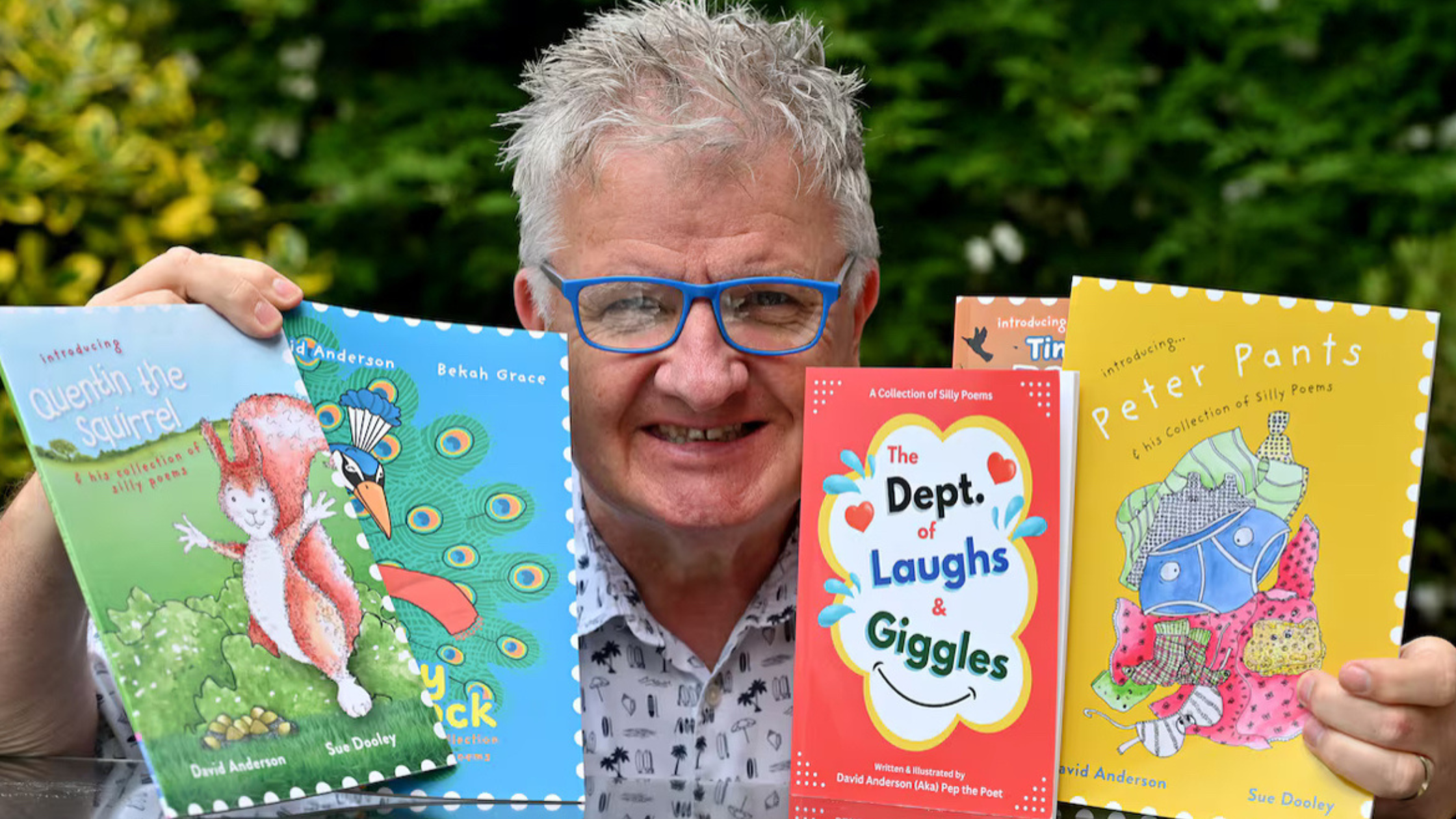
Katy Lassetter interviewed children’s poetry book author David Anderson (AKA Pep the Poet). They chatted about the size of sparrows, the joy of Tunnock’s Caramel Wafers, sniffing books, the value of patience and why a human touch matters when creating a book you’re proud to put your name to in an AI world.
Tell me about your books
My books are collections of poetry for children. They’re primarily very silly and I make no apologies for this. If we want formality and seriousness, all we have to do is open a newspaper or switch on the TV.
They offer a little world where we can escape reality, be silly, look at things from a different viewpoint and perhaps practise a few accents and dialects along the way.
Who are your children’s poetry books aimed at?
My books are aimed at children aged 7 to 11. Having said that, many adults have told me that they thoroughly enjoy reading them and giggling along the way.
If your books were a dessert, what would they be?
I think I’d choose an Eton mess: beautiful and sweet, but you never know what flavour is coming next. Is it going to be meringue? Strawberries? Whipped cream? I always think that the Eton mess is like the chameleon of desserts.
Where did the idea for your children’s poetry books come from?
The original idea for children’s poetry came to me in 1981, when I was 18. I was on holiday with my pals in Newquay, Cornwall. Our accommodation was quite a way out of town and one day, as we were walking in, one of my friends pointed at a small bird.
“Have you seen the size of the sparrows down here in Cornwall?”
We stared at him, agog. He carried on:
“If they came to Rugeley, our sparrows would knock them out!”
I couldn’t stop thinking about it. What if birds from different parts of the country chirped in their local accents? What about dogs? Insects?
That little conversation gave me the idea of insects with accents. Looking back, it was where the whole concept behind my work began.
What was your main inspiration to write a children’s poetry book?
Like many people, I had always had a book idea in my head and that’s where it had stayed for decades. It was my wife, Paula, who said that if I was serious about it, I should seek advice from others who had self-published and try to learn from their experiences.
Great advice from Paula. That’s exactly why I started this interview series!
Where’s your favourite place to write?
Anywhere quiet, really. I do like coffee shops, provided they’re not too noisy. I get distracted very easily when there’s a lot of background noise, although sometimes that can be useful if I’m looking for a bit of inspiration.
As a rule, I can write anywhere as long as it’s quiet and I have a pad, a pencil and my phone for my rhyming dictionary app.
What’s your favourite writing snack or accessory?
This is probably the easiest of all these questions. I was born in Scotland, so my snacks and drinks have a distinctly Caledonian slant. My go-to combination is a chilled Irn-Bru and the food of the gods: a Tunnock’s Caramel Wafer.
My favourite accessory is a rectangular piece of cloth with little pockets at the bottom where I can slip in pens and pencils. It rolls up and then a loop of cord keeps it all secure.
Oh, who can resist a Tunnock’s Caramel Wafer?!
How did you self-publish your children’s poetry books?
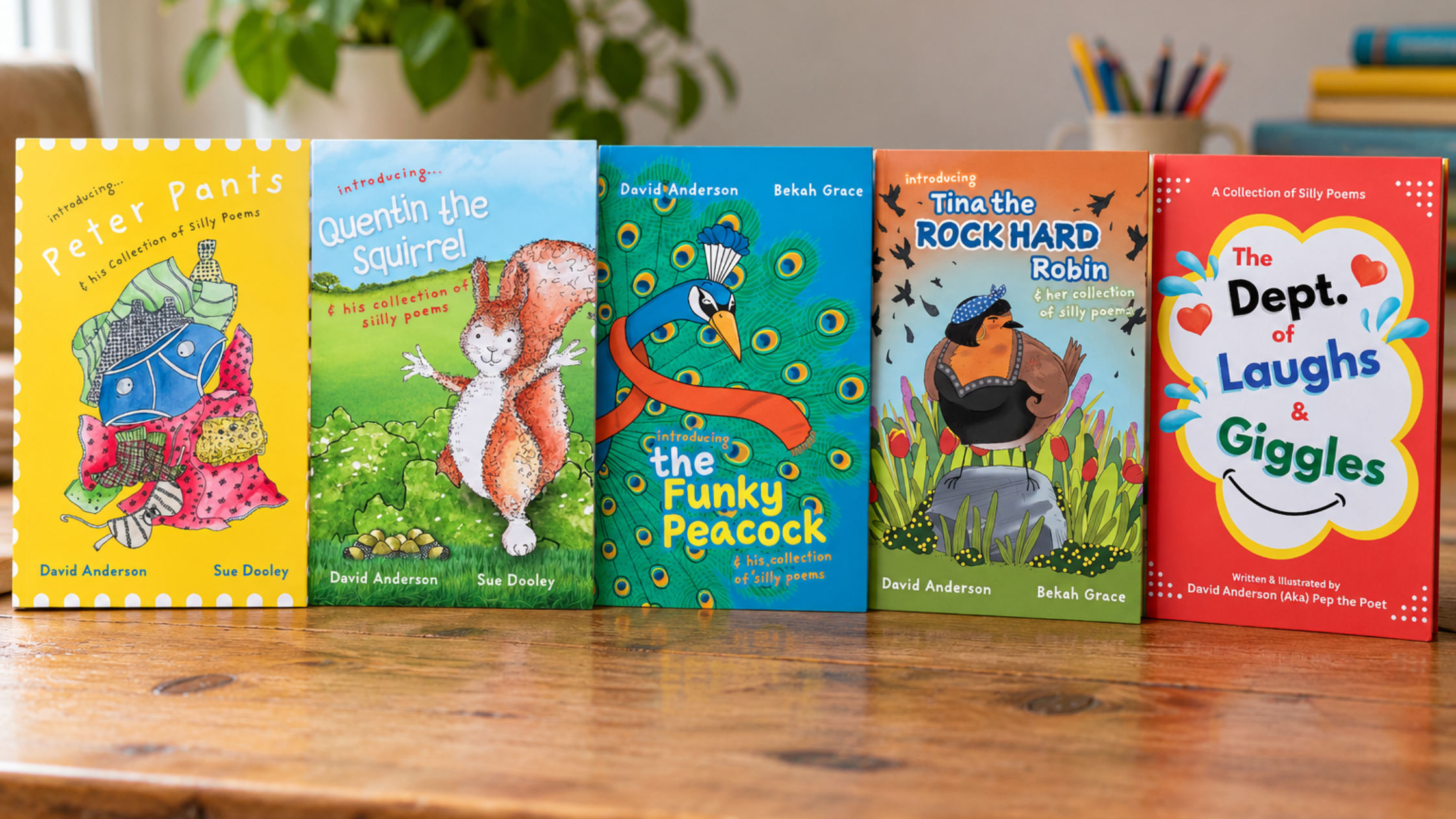
I have self-published all five of my children’s poetry books. My nephew, Matthew Edwards, has played a major role in bringing them together, collating my poems and digitally typesetting them into book format.
He also liaised with the illustrator and copyeditor to ensure everything went smoothly. I’ve been very blessed to have such a talented nephew.
All the printing has been carried out by Mixam Limited and they have been brilliant.
Did you have your cover art and illustrations created?
I have worked with two book illustrators, Sue Dooley and Bekah Grace, and they have both been brilliant.
Sue illustrated my first two books using traditional pencil and paint techniques. We then digitally scanned the images.
Bekah illustrated my third and fourth books digitally on her iPad. This made it easier for us to edit and revise the illustrations.
For my fifth book, I decided to have a go myself and created the illustrations using Procreate.
Did you have your books edited and proofread by professionals?
Yes, I worked with two different professional copyeditors and proofreaders. They were both brilliant. I know that new authors will be very tempted to use AI as it’s free and they think that they’re making a saving. But I really feel that you need that human touch.
What did professionals bring to your children’s poetry books?
I can’t stress enough how important it is to engage professionals to help you. I speak to so many people who say that a family member is at art college or that a friend works in an office and is brilliant at spelling. That may well be true, and their support can be valuable, but there’s nothing better than working with experienced professionals who understand what goes into producing a book.
A good illustrator, copyeditor or proofreader brings specialist skills and a fresh pair of eyes. They can spot things you’ve missed, offer advice and help you turn a collection of poems into a book you’re proud to put your name to.
What was the most satisfying part of the self-publishing process for you? What did you most enjoy?
I’ll start with what I found most enjoyable, which was creating and writing the book itself. Dare I say, that was actually the easiest part.
There are so many satisfying moments in self-publishing. But the one I remember vividly was the day the lorry arrived outside my house with a pallet of books. There, sitting in front of me, were my ideas, creativity and hard work brought to life.
Opening that first box and lifting out the first pristine copy of my very first book was an incredible feeling. Something that had started in my imagination was now a real book I could hold in my hands. It was a moment of pure pride and excitement that I’ll never forget.
The smell of the book was incredible. This is where I have to let you in on a little secret. I’m a secret book sniffer, and there are many more of us out there, but we like to keep it quiet. You’ll spot us in bookshops, libraries and book fairs, opening up a book and sticking our noses right into the middle of it. But remember, this is a secret between you and me…
I learnt recently that the much-loved old book smell has something to do with the familiar and nostalgic smell of vanilla (can you say Mr Whippy?). Wood pulp, which paper’s made from, contains lignin. As lignin breaks down with age, it releases vanillin, which gives that vanilla scent.
What was the hardest part of the self-publishing process for you? What lessons did you learn?
Getting the blessed book to market was the hardest part. Between the illustrations, editing, proofreading, layout, and printing, bringing everything together required time and immense patience.
The biggest lesson I learned was that you don’t have to do it all yourself. I’ve been incredibly fortunate to have my nephew guiding me through the process, alongside a team of wonderful illustrators and proofreaders. Their experience has been invaluable.
I also learned the value of patience. When you’re excited about a project, it’s tempting to rush to the finish line, but taking the time to polish the details and listen to expert advice makes all the difference to the final result.
What advice would you give to others looking to start the self-publishing journey?
You should always follow your dreams. Therefore, if you want to write a book, you MUST do it! But I’d add that self-publishing isn’t for the faint-hearted.
Writing, editing and rewriting a book is a huge task in itself. The publishing process can then be arduous if you haven’t done your research. People have had their fingers burnt by being too trusting. So, it’s important to know who you’re working with and exactly what you’re paying for.
Nevertheless, the toughest part by far is getting your books to market. Actually, selling the little blighters is really tough. My advice would be to become as media-savvy as possible. Social media and the internet can be incredibly useful for reaching readers and promoting your work, but it takes time, effort and persistence.
Do you have plans to write or publish any more children’s poetry books?
I do indeed. I’ve written about two-thirds of the poems for my sixth collection of poetry for children. I even have the title: The Ministry of Mirth and Merriment. I’m also contemplating using AI to help me with the illustrations.
An idea for a children’s book has also been rolling around in my head for almost two decades. All I need is some time and space to sit down, plan it and begin writing.
What would you do differently next time?
My initial excitement and eagerness to get things done led me to make a few mistakes. Next time, I’d be more patient and avoid rushing into things because those mistakes can end up costing you hundreds of pounds.
I’d also spend more time researching who else is writing for my intended audience. What books are selling? What are readers looking for? And, of course, the million-dollar question: is there actually a market for what I’m writing?
Self-publishing is hard work, but the pride and joy of finally holding your finished book in your hands make all the hard work, stress and anxiety worthwhile in the end.
Professional self-publishing support for your children’s poetry book
As David says: “A good illustrator, copyeditor or proofreader brings specialist skills and a fresh pair of eyes. They can spot things you’ve missed, offer advice and help you turn a collection of poems into a book you’re proud to put your name to.
Fellow children’s poetry, picture book and YA fantasy author Nate Pugh saw the value of my professional editing and proofreading services for five of his books:
“Without Katy, my books would be far inferior. A good story is great. But without the correct grammar and punctuation, it will frustrate and test even the most patient of readers. Katy’s attention to detail is breathtaking. With her editing service, she goes beyond proofreading, suggesting subtle tweaks that will enhance the overall reader experience while identifying and developing any gaps in the flow of writing. She’s a pleasure to work with and a true professional.”
But I’m not just a professional editor and proofreader. I can help you with all stages of the self-publishing process. This includes:
- Typesetting — to make your book easy on the eye and easy to read
- Cover design — because readers do judge it
- Manuscript uploads — setup and submission of your book to a publishing platform of your choice, with metadata preparation and support.
- Printing — on-demand online or through a specialist printer
- Book marketing and PR — to help you fly up the bestseller charts
My Self-publishing Surgery is the ideal place to start. This is a 1:1 consultation with a full review and report. You can ask me anything to get the clarity and confidence you need about your writing, publishing and/or book marketing
And with my seamless self-publishing project management service, you’ll avoid the stress and anxiety David mentions to stay on track and meet your book launch date. Author Sharon Brisley-Moore endorses this:
“Katy, from our very first phone call, put me at ease, holding my hand through the whole process. By giving her all, Katy gave me a finished product I am proud to show the world”.
Do you want me to make your children’s poetry book fly? Get in touch to find out more about my professional self-publishing services.