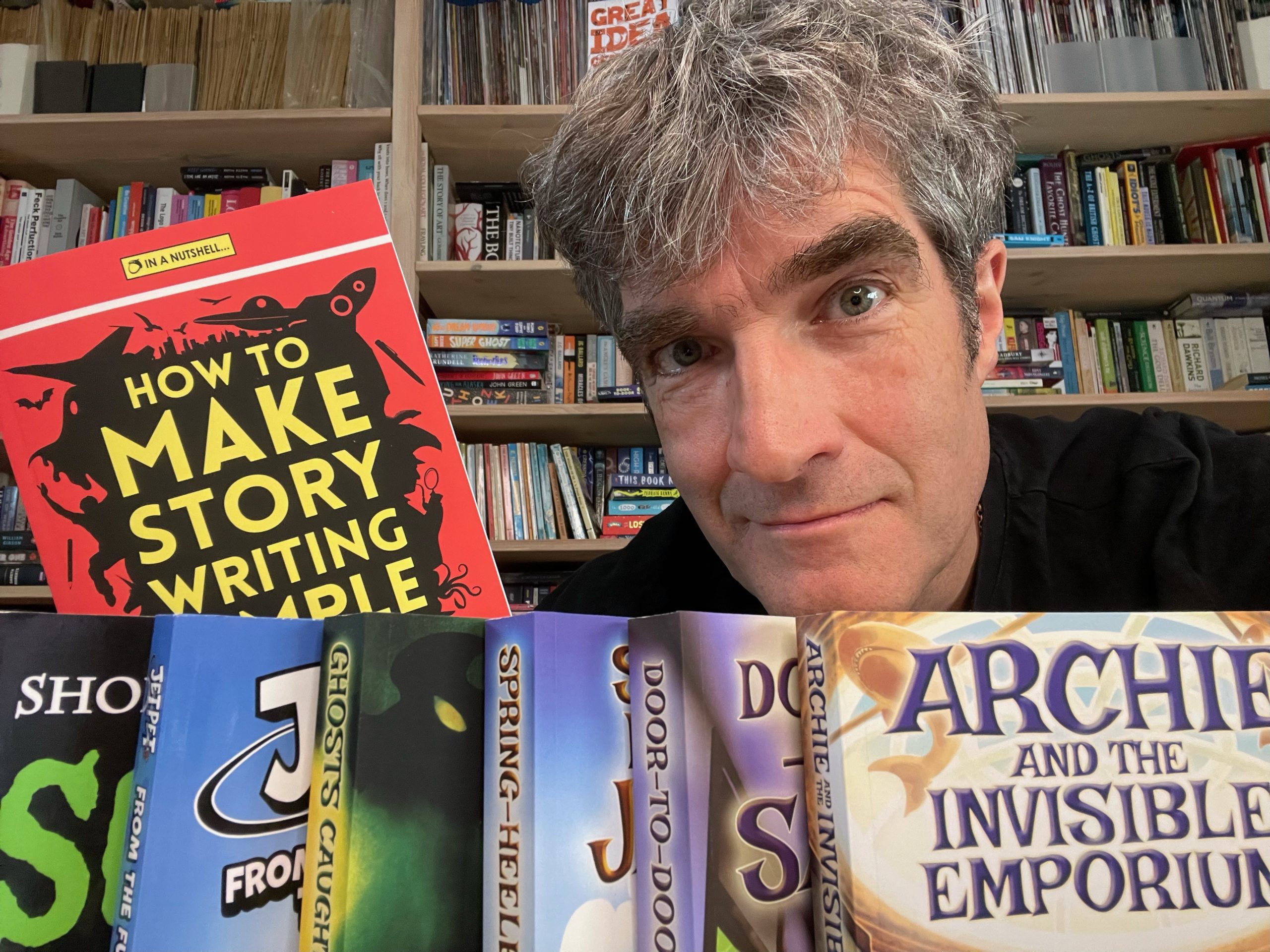
In number seven of the ‘Chichester Copywriter Chats’ series, Katy Lassetter talks to children’s book author Douglas Caleb about how he’s taken care of the self-publishing process himself. And how novel writing prepared him for a copywriting career, where he’s known as Doug Smith.
Tell me about your children’s books
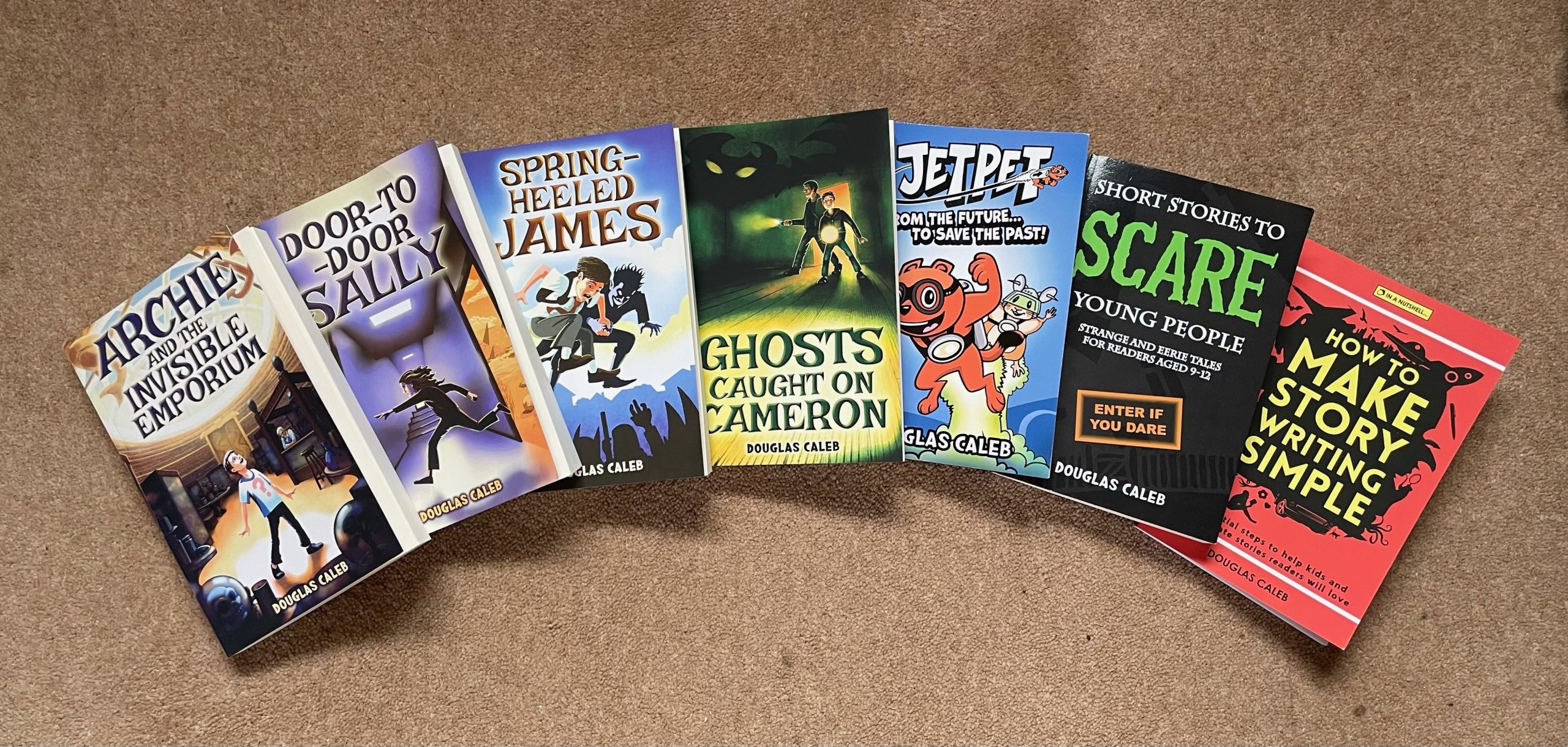
My main four books make up a series under the Our Weird World banner – Archie and the Invisible Emporium, Door-to-Door Sally, Ghosts Caught on Cameron and Spring-Heeled James.
They’re all stories of ordinary kids caught up in extraordinary circumstances or strange supernatural situations. They explore the adventures the kids have navigating their way and, somehow, making it to a happy ending. Ghosts Caught On Cameron was a finalist in the Wishing Shelf Book Awards 2024.
There’s also Jet Pet. It’s about two cute animals with jet packs, sent from the future to stop an evil rogue salmon from flooding the world and changing time. And Short Stories to Scare Young People does what it says on the cover 🙂
Finally, I created a quick guide to demystify the story writing process called How to Make Story Writing Simple. But I think it’s had more adult buyers than kids!
It just goes to show that adults appreciate simplicity in their how-to guides. And we’re all big kids at heart.
Who are your children’s books aimed at?
Middle-grade kids, ages 8-12.
If your children’s book series were a cake, what would it be?
I’d probably have to go with Black Forest gateau. Sweet, surprising, multi-textured and dark all at the same time. Always leaving you wanting more when you’re done.
Oh, nicely done. I’m licking my lips in anticipation…
Where did the idea for your children’s books come from?
Sometimes I’m inspired by real legends or modern myths – like with Spring-Heeled Jack. Sometimes it’s adverts – like when Jennifer Aniston crawled into a kitchen cupboard and emerged in a Caribbean beach bar in a ‘90s travel company ad. Sometimes I mix two ideas – ghost hunting and fatherhood. And other times it’s simply a mash of magical objects, tales and personalities.
What was your main inspiration and motivation to write children’s books?
Simple, raw creativity. Ideas and concepts kept (and still keep) coming into my head, and many of them I feel strongly enough about to develop.
Then, there’s the possibility of fame and appreciation. But really, I just wanted to make my ideas real and for other people to be caught up in the magic, too. Just like I got caught up in Doctor Who, Star Trek or The X-Files.
Where’s your favourite place to write?
In any room with a closed door 🙂
What are your favourite writing snacks?
Coffee or cranberry juice, and I keep a stash of peanuts in a drawer just in case.
Every good writer needs just-in-case peanuts!
As a copywriter, did you find parts of the children’s book writing process easier or more challenging?
It actually worked the other way around, as I started writing novels before becoming a copywriter. I found spinning a narrative or understanding structures of landing pages, blogs and emails quite straightforward thanks to writing.
The best thing about children’s book writing is finding empathy for your characters. And empathy with your audience is one of the most important aspects of copywriting, I think.
Being a copywriter obviously came in handy when drafting the book description, etc.
I agree, Doug. Empathy all the way!
How did you self-publish?
Originally, I formatted the manuscript in Word and the cover in any application that could generate a PDF, to the precise dimensions given by self-publishing site Lulu, and then uploaded everything to the platform to print on demand. This was for a writing group’s anthology and an idea-generation activity book I created 11 years ago.
In the last year or so, for all the books I mention here, I used an application called Atticus to format all the interior content. It makes everything simpler in terms of margins, fonts, trim sizes, page numbering and front and back matter. It also outputs for print and eBook.
Did you have your children’s books typeset?
Atticus handles typesetting nicely.
Did you have your cover art and illustrations created by a professional?
I created them all myself! I went to art college and so wanted to use my skills to create the full book package as author and illustrator. I used a mix of pencil drawings and Procreate to bring it all together. The downside is that it takes up way too much time that could have been better spent getting on with the business of writing and marketing.
But I’ve engaged a cover designer for my next book, to save time and get better skills than mine on the case. I’m waiting for the results as we speak. Their advice during conversations before starting work led to a far clearer approach to the final image. Can’t wait to see how it turns out!
Did you have your children’s books edited and proofread?
Again, I did it all myself. But I did have several volunteer beta readers who read through the manuscripts pre-publication to catch daft typos and silly inconsistencies. For my latest WIP, I’ve started using ChatGPT to give feedback chapter-by-chapter before asking beta readers. It’s been useful for spotting typos, emotional gaps and lulls in pace. But it’s sometimes useless with consistency and occasionally dreams up extra scenes and characters!
Would I use editing and proofreading professionals in the future or recommend them to others? If you can spare the cost, it’s definitely worth saving the time, as well as getting external input on your work.
What was the hardest part of the self-publishing process for you?
Aside from illustrating, I’d have to go with writing the book descriptions. I said being a copywriter made them easier, but I find it a real challenge to talk about my own stories in that commercial sense. This could be because I can’t see the wood for the trees, and I’m clouded by knowing and wanting to convey EVERYTHING. What’s the highlight? Do I really have to leave out that cool detail? Argh. I followed a copywriter who said, about trying to market yourself, “You can’t read the label from inside the bottle.” And she was right.
What was the most satisfying part of the self-publishing process for you?
It’s got to be getting that first positive feedback or review – it validates all your work. Closely followed by opening the package with your proof from the printer and seeing the results of your ideas and hard work there in print, in a hard copy you can actually smell 🙂
What advice would you give to other writers looking to start the self-publishing journey?
Don’t be put off by the technical side of self-publishing. In the end, it’s all quite procedural. Platforms like Amazon KDP and Bookvault provide clear guidelines on how to format and submit your work.
Do you have plans to write and publish any more children’s books?
Oh yes. I’ve got two more in the pipeline for the latter half of the year. The Sky Captain’s Son is a steampunk for kids adventure. Downloadable Arthur is about an AI friend who’s more than he seems…
I’ve also got ideas for a horror romance series and a younger reader book called Kevin the Teenage Unicorn and the Magic Vampire Bunnies Hunt for Dragons.
Wow, what a fantastical title – colour me intrigued!
What would you do differently next time?
Get someone else to do the covers. Or see if I can train an AI on my previous work/style for the internal black and white line art illustrations. That’ll probably get the pitchfork-wielders coming for me. Oh well.
From children’s book author to copywriting career
So, Douglas Caleb has learnt his craft from creative writing, turning it corporate with copywriting. Unusual, I like it. And his creative background has enabled him to tackle everything from book cover design to proofreading himself. With a little help from AI…
This has helped him keep the self-publishing costs down, but has it saved him time and offered clarity? He admits that doing it all himself has been time-consuming, and he can’t always see the wood for the trees. He also warns that his robot friends aren’t reliable when it comes to consistency – something many find when using AI for writing or editing. And nothing beats getting an extra pair of human eyes and professional input on your book to ensure it’s polished.
But what about all those wonderful resources Douglas mentions? Lots of food for thought and self-publishing options!
Professional editing and consultation for your children’s book
A recent client said I helped him see the wood for the trees with my developmental editing service. I’ve also edited and proofread an internationally bestselling children’s book.
Do you want to see the full picture and make your children’s book shine? As well as professional editing and proofreading, I can provide everything from typesetting and publishing to marketing and PR.
I’ll even project manage the entire self-publishing process to take away your worries, as I did for Sharon Brisley-Moore: “Katy, from our very first phone call, put me at ease, holding my hand through the whole process. By giving her all, Katy gave me a finished product I am proud to show the world”.
Are you starting your own self-publishing journey, but not sure what’s next? I’m here to guide you down the right path with my Self-Publishing Surgery. This is a 1:1 session where you can ask me anything about the self-publishing process, book launches and how to create a bestseller. Book before the end of October 2025 for £100 (special offer price, usually £150).
Get in touch for professional self-publishing services for your children’s book.