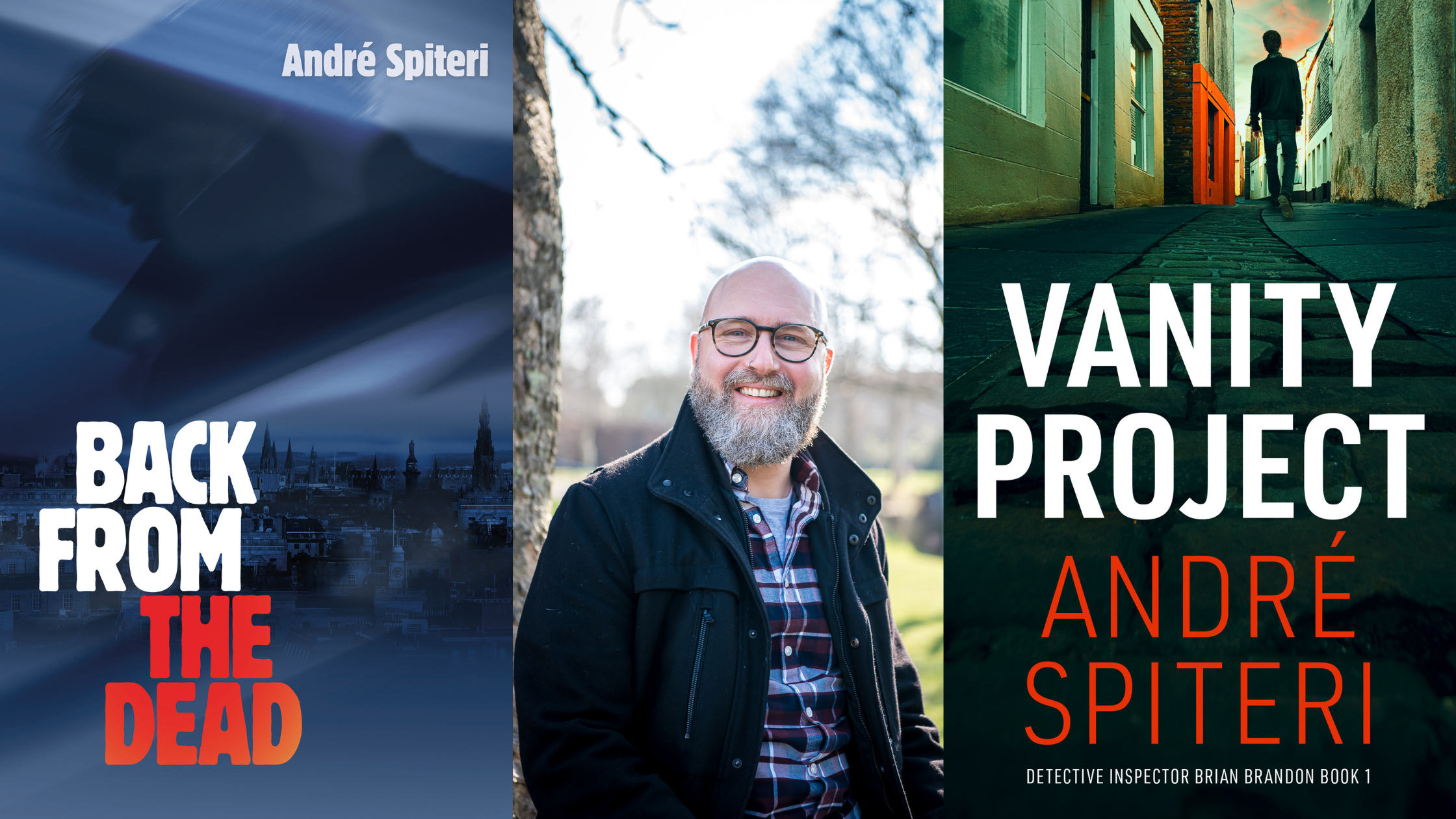
In the first of the ‘Chichester Copywriter Chats’ with self-published authors series, Katy Lassetter interviews crime fiction author and INDIEVERSE AWARDS 2024 nominee André Spiteri.
At the end of November, André Spiteri launched Vanity Project, his second crime novel for adults. As a fellow copywriter and author, André’s writerly rap sheet is far from elementary, my dear readers. So I asked him for insight into his writing and publishing journey – grit, gore and all. Will André spill his guts? The big reveal is on a knife-edge…
Tell me a bit about your books.
I’ve got three books out so far: Back From The Dead, Vanity Project and With Friends Like These... They’re loosely linked, in that they’re set in the same fictional city. Vanity Project, which is my second novel, refers to some of the events in Back From The Dead and a few characters make cameos. But they’re standalone novels in different crime subgenres.
Back From The Dead is an organised crime thriller. It opens with Bertie Haig, a hapless everyman, finding a random dead stranger in his bed. But it’s really the story of Al Edwards, a high-ranking gangster whose mother’s harebrained get-rich-quick scheme forces him into an impossible position. That kicks off a chain of events, which culminates in a deadly gang war.
Vanity Project is a police procedural (a novel based on how the police investigate and solve a crime) and the first of what I hope will be a series. A freelance cybersecurity consultant is stabbed to death in his home. At first, it looks like his wife and her lover did it. But the case runs much deeper.
With Friends Like These… happens around seven months after Vanity Project. There’s a private party on a tidal island. Fire and Rescue get called, and a body’s found burnt to a crisp in a tent. It’s arson, and the bloke’s been bashed over the head with a blunt instrument, which makes it sound like murder. His friends seem very cagey, but it turns out the victim was involved in some pretty grim criminal stuff. Could it be he p*ssed off the wrong people?
Knowing how much most writers love a sweet treat to keep the words pumping, if your book series was a cake or a drink, what would it be?
My books wouldn’t be cakes or drinks. They’re the horrendous motorway pileup you can’t tear your eyes away from ha ha!
Where did the idea for your crime fiction come from?
I don’t have ideas for books, per se. And no, I’m not trying to dodge the question. Normally, a situation and an opening sentence pop into my head. I might have a vague idea of where I need to end up at some point, but not always. Then I pretty much go with my gut and hope it all comes together at some point.
What was your main motivation to write a book?
I’ve always wanted to write one. When I was seven or eight, I’d copy out Enid Blyton stories by hand and tell my cousins I wrote them (they played along, ha ha).
Then I graduated to writing my own. I wrote several really bad short stories and tried my hand at writing a novel a few times. But it never really worked out, so I put it on the back burner.
Around two years ago, I learned about #2BadPagesADay (via Fiona Melrose on Twitter), which is exactly what it says: you write two pages a day. That did the trick, because two pages are short enough to be doable, but it adds up fairly quickly. I finished Back From The Dead in two and a half months and now I can’t stop.
Where’s your favourite place to write?
These days, my office. But I wrote most of the first draft of Back From The Dead on my phone during dead times in my day (no pun intended, I’m sure, André!)
What’s your favourite writing snack?
Coffee. Lots and lots of coffee.
As a copywriter, did you find parts of the book writing process easier or more challenging?
Copywriting and writing crime fiction are very different skills. The former is a sprint. The latter is a marathon — a test of endurance.
The novel doesn’t play to my strengths, if I’m honest. I’m spontaneous and instinctive. I throw stuff at the wall and see what sticks, whereas there’s a lot of logic and planning involved when you’re writing a novel. Even if you approach it the way I do, making it up as I go along, you’ll have to plan eventually. It’s why I ended up rewriting both my novels from scratch at least once.
Of course, it’s immensely fun and liberating to be creative on your own terms. But I’ll admit I did struggle with not having a client to make the decisions when I wasn’t sure which way to go.
Did you have your book typeset and have cover art created?
Yes, I used software called Vellum for typesetting. I also had cover art done. People do judge a book by its cover, despite the saying. Having an eye-catching, genre-appropriate cover is important.
Did you have your book edited and proofread?
For both novels, I had a developmental edit and a copy-edit. Then, after typesetting it and changing to epub format, I re-read it myself on my Kindle (a very different experience to reading on your monitor).
Normally, what happens in this last read-through is that I delete a bunch of stuff – adverbs, repeated phrases and metaphors I feel are a step too far.
Did you use professionals for these services and, if so, what did they bring to the table?
My editor is essential to my process. I’m the kind of writer who’s too busy thinking about how lovely the forest will look when it’s in bloom to worry about where I should place the individual trees. She points out all the things which I know are wrong with the story but can’t quite articulate for myself.
Usually, I’ll do a completely unplanned first draft. Then I’ll tighten it and send it for a developmental edit. That comes back with a lengthy report on what’s working and what isn’t, plus in-manuscript comments. I’ll have that marked-up draft on one screen and rewrite the whole thing from scratch in a fresh document on another screen. It’s as intensive as it sounds.
With Vanity Project, most of the material from the first two drafts didn’t make it to the final manuscript. About 75% of what I wrote after the developmental editing was new.
My designer brought market knowledge to the table. The key with book cover design is that it’s not an art project. It’s about setting the reader’s expectations, particularly when it comes to genre. You need somebody who can help you visualise that.
I wouldn’t be able to do it without my editor or a good cover designer. The dev edit is critical to my process, and I can’t use Canva to save my life.
How did you self-publish? Did you use a product or did you create the books yourself and engage a printer?
I uploaded the files to Kindle Direct Publishing (KDP). Amazon do print on demand – as do other companies like Draft2Digital, so there’s no need to print copies ahead of time.
What was the hardest part of the self-publishing journey for you?
The hardest part was the learning curve. I wasted a lot of money on things that didn’t work when I published Back From The Dead. I did Vanity Project on a far leaner budget, and I think it’s a better product.
What’s the most satisfying part of the self-publishing process for you?
I won’t pretend I have it figured out, because I don’t. But now I have a process in place, and trusted collaborators, I enjoy the control.
I think the difference between self-publishing and traditional publishing is a bit like the difference between being freelance and employed. Some thrive as freelancers, some don’t – and that’s OK. As somebody who’s been a freelance copywriter for going on 10 years, I’m comfortable making my own decisions and taking charge. And I like that about self-publishing, you’re not at the mercy of a gatekeeper’s whims.
What advice would you give to other writers looking to start the self-publishing journey?
First, understand it’s not a get-rich-quick scheme. You must think long-term.
Second, and I realise this probably isn’t helpful, you need to figure out what works for you.
As with the freelance world, there’s lots of conflicting advice (and pricey courses) out there. With self-publishing, there’s the added complication that every writer and every book is different. There’s no one-size-fits-all and, so, no avoiding the trial and error.
Do you have plans to write and publish any more books?
I’m working on a sequel to Vanity Project as we speak. I’m still wrestling with the first draft, but I’ve reached the endgame, and I know where I’m going with it. I just need to actually write the bloody words down and make sure they’re at least semi-coherent.
What would you do differently next time?
There are a few things I did differently with my second book. First, I saved a huge amount of money by not paying to be on review sites like NetGalley. The reality is that, as an unknown or new author, not many people will download your book. And most of those that do will do so because it’s free, and then they will never read it. It’s better to run a promotion on launch, as you’re more likely to find your audience, people who will actually rate and review your book.
Second, I focused more on my mailing list. These people are already interested, and they’re more likely to leave you a positive review than readers who aren’t on your list. You need friendlies to start with, until your book finds your audience.
Third, I approached cover design completely differently. The first time around, I didn’t know how to brief my designer, so the results were disappointing. This time around, I approached it commercially:
- Instead of looking at covers I liked for inspiration randomly, I looked at covers I liked specifically in my book’s genre.
- As I already mentioned, the cover isn’t about the art, it’s about setting readers’ expectations. If you’ve written a thriller, your cover must look like a thriller cover. If you’ve written a romance, your cover must look like a romance cover. Once you understand those constraints, it’s much easier to come up with a good cover that works for your book.
Crime fiction pays
How’s that for a felonious amount of fodder for upcoming self-publishing authors? And they say crime doesn’t pay!
Wondering where to start? You can kick off with the seed of an opening line, write two pages a day on your phone and fuel up with plenty of coffee!
Then where do you go? Collaborate with professionals (accessories, if you will) for an OG developmental edit and a book cover design that’s more iconic than the Kray twins.
As a big crime fiction fan, André’s book is at the top of my ‘to be read’ pile. Here’s hoping you’ll give it a read too and learn something about the self-publishing process from someone who’s done it twice – and managed to bag himself an award nomination!
Killer self-publishing support
If you’d like to start by getting a professional freelance editor with publishing experience onboard, I’m here to help. I’ve supported bestselling authors of children’s books, young adult fantasy fiction, educational resources, memoirs, self-help books and more.
I can assist with the entire self-publishing journey – from editing and proofreading packages to typesetting and marketing – to get your book in bestseller shape. And you don’t have to be a Chichester author, I work remotely with authors all over the UK.
Email me or call 07986 802194 to book a £150 Self-Publishing Surgery (all your questions answered and best-practice advice given in one hour) or for an editing quote.