In the sixth of the ‘Chichester Copywriter Chats’ series, Katy Lassetter interviews non-fiction book author Tom Albrighton about his writing, freelancing and introversion titles.
By self-publishing six non-fiction books that started as a passion project, Tom Albrighton’s helped a heap of fellow freelance writers to thrive. Just as he shares his industry and personal experiences in his books, Tom reveals a wealth of knowledge here to help you make the right decisions on your self-publishing journey.
Tell me about your non-fiction books
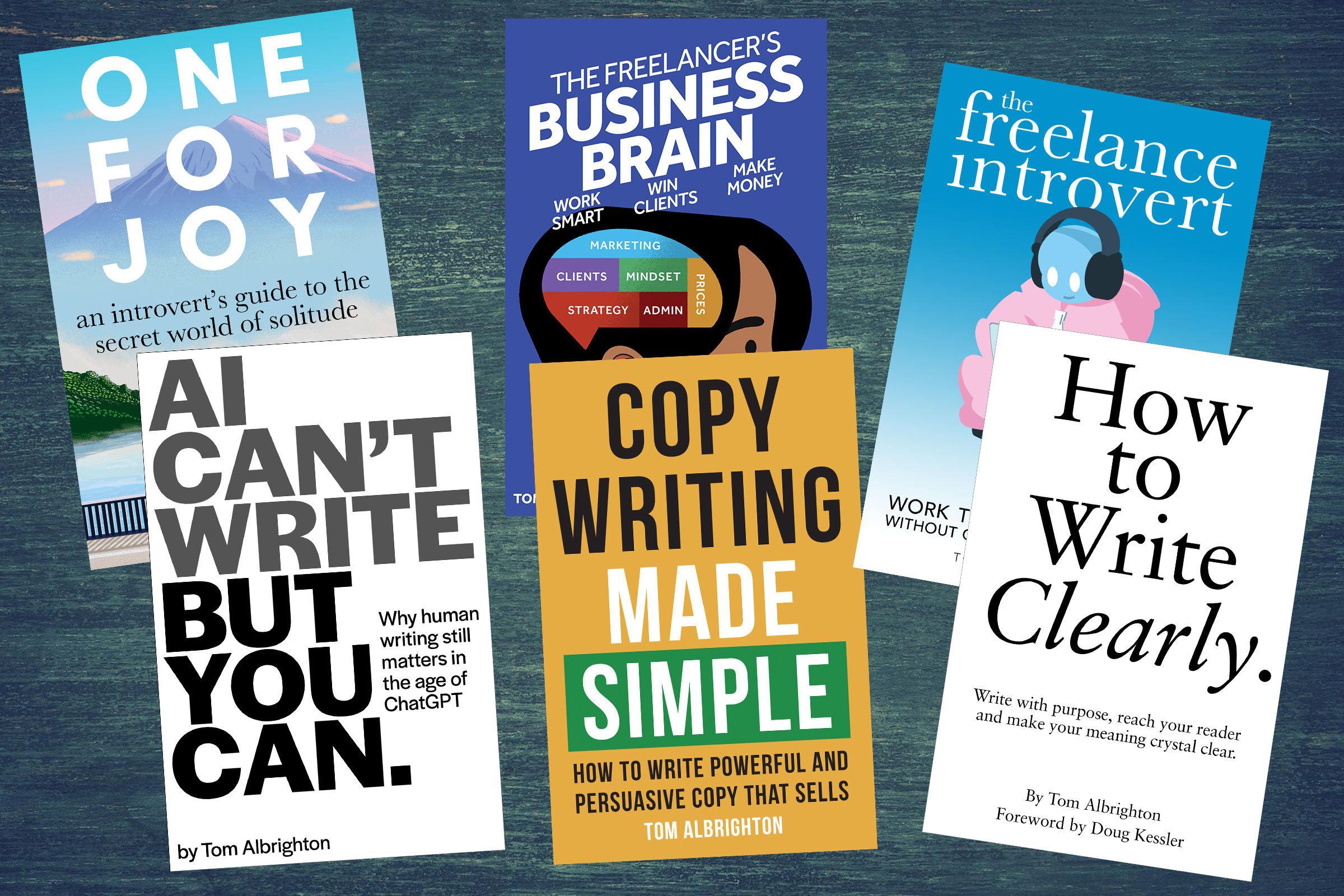
I’ve written six non-fiction books now. There are three on writing (Copywriting Made Simple, How to Write Clearly, AI Can’t Write, But You Can), two on freelancing (The Freelancer’s Business Brain, The Freelance Introvert) and one on introversion and solitude (One for Joy). All my books are available in ebook, paperback, hardback and audio. You can find out more on my website.
Who are they aimed at?
I guess they’re all aimed at people like me, one way or another. Maybe those at an earlier stage of life, who are considering a career like mine. I’m just trying to share the things I’ve learned.
If your non-fiction books were a cereal, what would it be?
Maybe Corn Flakes. You worry that they’re going to be dull, but once you get into them, they’re actually a lot nicer than you expected.
I like that. And each one’s a bit of a classic, with no intended crunch?!
Where did the idea for your non-fiction books come from?
Copywriting Made Simple was my ‘side hustle’ after I stepped away from running ProCopywriters, which I originally co-founded. I wanted a passion project that wasn’t client work, and that was what I came up with.
Since then, each successive idea has just come naturally. The idea floats into my mind, I open a document and put down some thoughts. Then, before I know it, I’m working on a non-fiction book. But some don’t make it to publication.
What was your main motivation and inspiration to write a non-fiction book?
I used to put a lot of effort into blogging on my own website, before social sites like LinkedIn and Substack took over that role. I was proud of what I wrote, but it was completely ephemeral – here today, gone tomorrow. I wanted to write something more enduring and perhaps get paid for it too.
Inspiration-wise, I’ve always wanted to emulate the great self-help books, like Stephen R. Covey’s Seven Habits of Highly Effective People. People look down on self-help as a genre, but I got my start in freelancing through redundancy, and those authors really helped me when I lacked direction in the early days. So, I hoped I could play a similar role for someone else in that situation.
Where’s your favourite place to write?
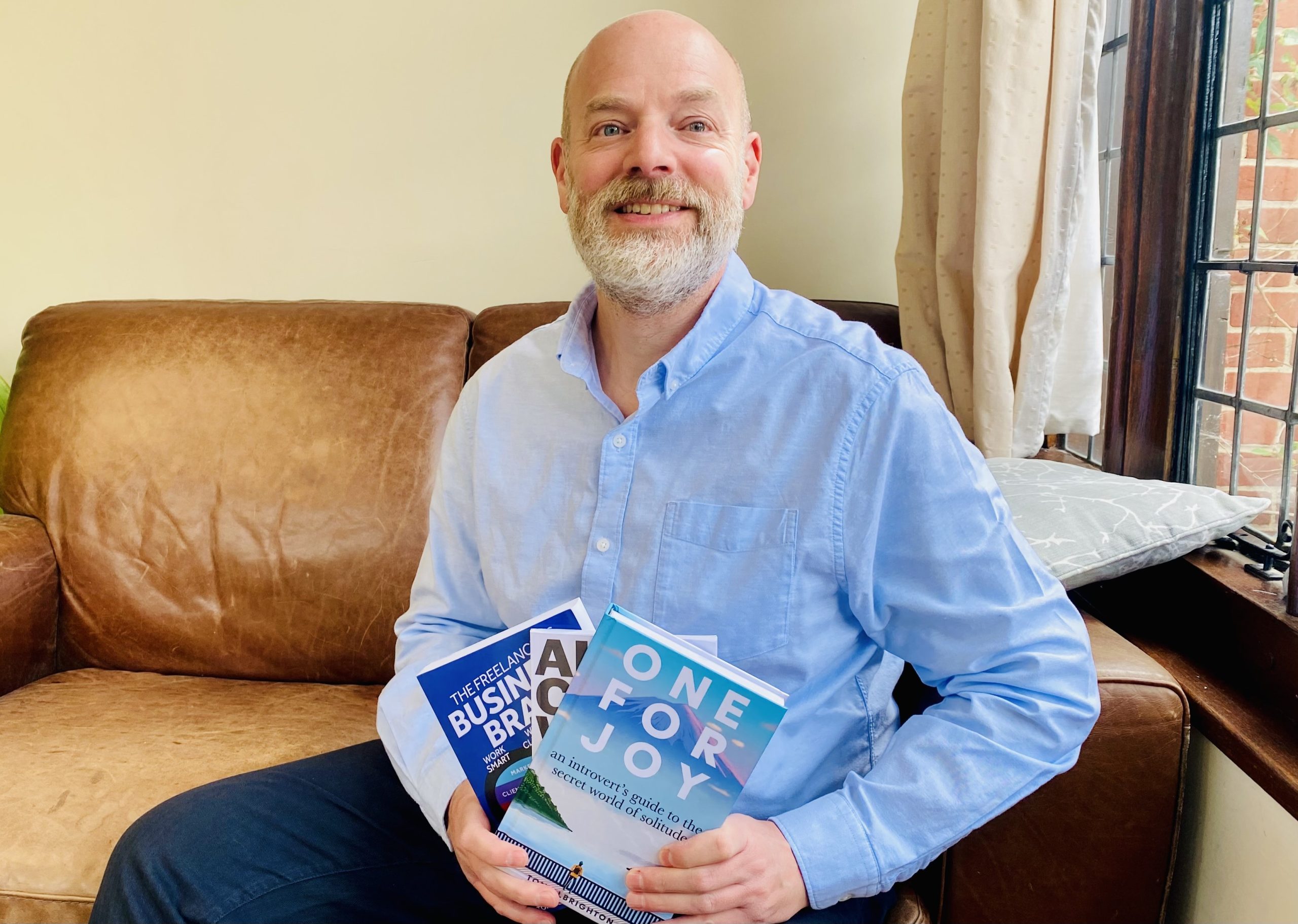
In my conservatory, with a view of the garden. That’s where I am in the photo. Although it’s distracting if the lawn needs mowing.
I hear you, Tom. The birds outside my office window often distract me. But, as a wordy bird nerd, I’m not complaining!
What’s your favourite writing snack?
Nothing but black coffee until midday. Then things go badly wrong in the afternoon – probably Mini Cheddars or salted peanuts.
Early evening, I might write with a beer to hand if I need to do something more creative and the words just aren’t flowing. ‘Write drunk, edit sober’ does work sometimes.
As a copywriter, did you find parts of the book writing process easier or more challenging?
Well, writing about writing sets a pretty high bar. You have to walk the talk, and any advice you give the reader has to be consistent with itself, so you’re constantly at risk of undermining yourself.
I spent about a year on Copywriting Made Simple, particularly in the areas where my expertise wasn’t so deep. But I was originally an editor, and I still do editorial work, so I actually prefer the refinement to the first draft. I don’t mind sitting with something until it’s right, and I know it always takes longer than you think.
So, you wear copywriting and editing hats, just like me!
How did you self-publish?
I used a packaging service at first, but then I decided I could just as easily do it myself on Amazon’s KDP, so I’ve been on that for a while.
Did you have your non-fiction books typeset?
The packaging company did offer this service. But I quickly realised that I needed more control, and requesting and checking text amends was going to be a nightmare. So, I asked a designer to do it in InDesign and sent a PDF to the packager instead. Later still, I realised that Word can support a fairly complex book design if you know how.
Did you have your cover art and illustrations professionally created?
I have used designers for covers in the past. But more recently, I’ve tended to do it myself, since I’ve got enough Photoshop skills from my publishing days. For cover and internal illustrations, I’ve commissioned illustrators.
Did you have your non-fiction books edited and proofread by professionals?
Some, yes.
What did professional editors and proofreaders bring to the table?
They gave me valuable feedback on parts that weren’t working – self-indulgent bits, things that were in the wrong place and so on. They also encouraged me to cover topics that I’d shied away from, usually because I was too lazy. Plus, general help with usage and grammatical structures. I tend to miss words out, which is quite hard to spot once you’ve done it.
Would you use professionals if you self-published again?
I’m an editor myself, so I know how important their contribution can be. But with self-publishing, it’s easy to spend a fortune on developing your book that you never get back. I can also tell, from looking at other people’s books, that a few errors probably won’t affect the (modest) sales of a self-published book anyway. So, I sometimes just rely on my skills, for better or worse.
What lessons have you learnt from the self-publishing process?
Well, one commercial lesson is that the self-publishing industry makes its money from authors, not books. As an author, you’re the product.
There’s an army of people out there promising to help you write, market and sell your book, and a wealth of often contradictory advice too.
I’m not saying these services don’t have value, or that everybody is out to con authors. You just need to keep your eyes open and be mindful of your aims.
What was the most satisfying part of the self-publishing process for you?
Getting positive reviews is wonderful, particularly when people respond in just the way you were hoping. On the other hand, negative reviews can be devastating, no matter how well-founded they are. That’s why I only look at five-star reviews now.
It’s also important to remember that reviews aren’t your ‘report card’ as an author. They’re written by readers for other readers, so in a way, you’ve got no business reading them anyway.
What advice would you give to other writers looking to start the self-publishing journey?
Clarify your goals. Do you want sales, publicity, a traditional publishing deal or just a hobby and the fun of writing and publishing a book?
When you self-publish, you can easily dedicate your entire life to trying to sell more books, going down the rabbit hole of marketing, technology platforms, social media and whatnot.
But you might get more enjoyment, and possibly even more sales, from simply writing another book instead. So, try to have a plan from the start, and put your time and energy where it brings you most rewards.
Do you have plans to write and publish any more non-fiction books?
I’m working on a novel, but it’s proving harder than I thought.
We’ll watch this space…
What would you do differently next time?
I guess I could have ‘written to market’ a bit more – that is, researched underserved niches and then aimed to meet them. But you have to believe in your work, or you won’t be motivated to create it. If you don’t like your own book, what’s the point?
From copywriter to non-fiction book author
As the co-founder of ProCopywriters and an experienced editor to boot, Tom’s got lots of self-publishing insight and advice:
- Choose your self-publishing support services carefully.
- Let your editor play devil’s advocate and get the best out of you.
- Enjoy five-star reviews, but remember they’re not the be-all and end-all.
- Have a clear plan of what you want to achieve.
Now, if that doesn’t help you on your self-publishing journey, I don’t know what will. Apart from Chichester Copywriter’s (con-free) self-publishing services of course…
Self-publishing support from another writing and editing professional
When even copywriters like Tom Albrighton, Tim Tucker, Sarah Townsend and André Spiteri call on professional editors and proofreaders to smarten up their self-published books, there’s no better advocacy.
As well as being part of their cool copywriting collective, I’m a professional editor and marketer. This means I can support your entire self-publishing journey with:
- Developmental editing
- Line editing
- Copyediting
- Proofreading
- Marketing and PR
My team can also help with typesetting and seamless manuscript uploads. And as an experienced project manager, I’ll ensure your self-publishing process is hassle-free and that you meet key milestones on time and within budget.
Email me or call 07986 802194 for a free editing and proofreading quote. Got lots of questions and want a writing, publishing and marketing plan? Contact me to book a Self-Publishing Surgery (best-practice advice on everything you need to know) at the special offer price of £100 (August-September 2025).
I’m invested in every author I help and want them to thrive. So, whether you write non-fiction books or romance novels, I’ll make sure you create and sell books we’re both proud of.