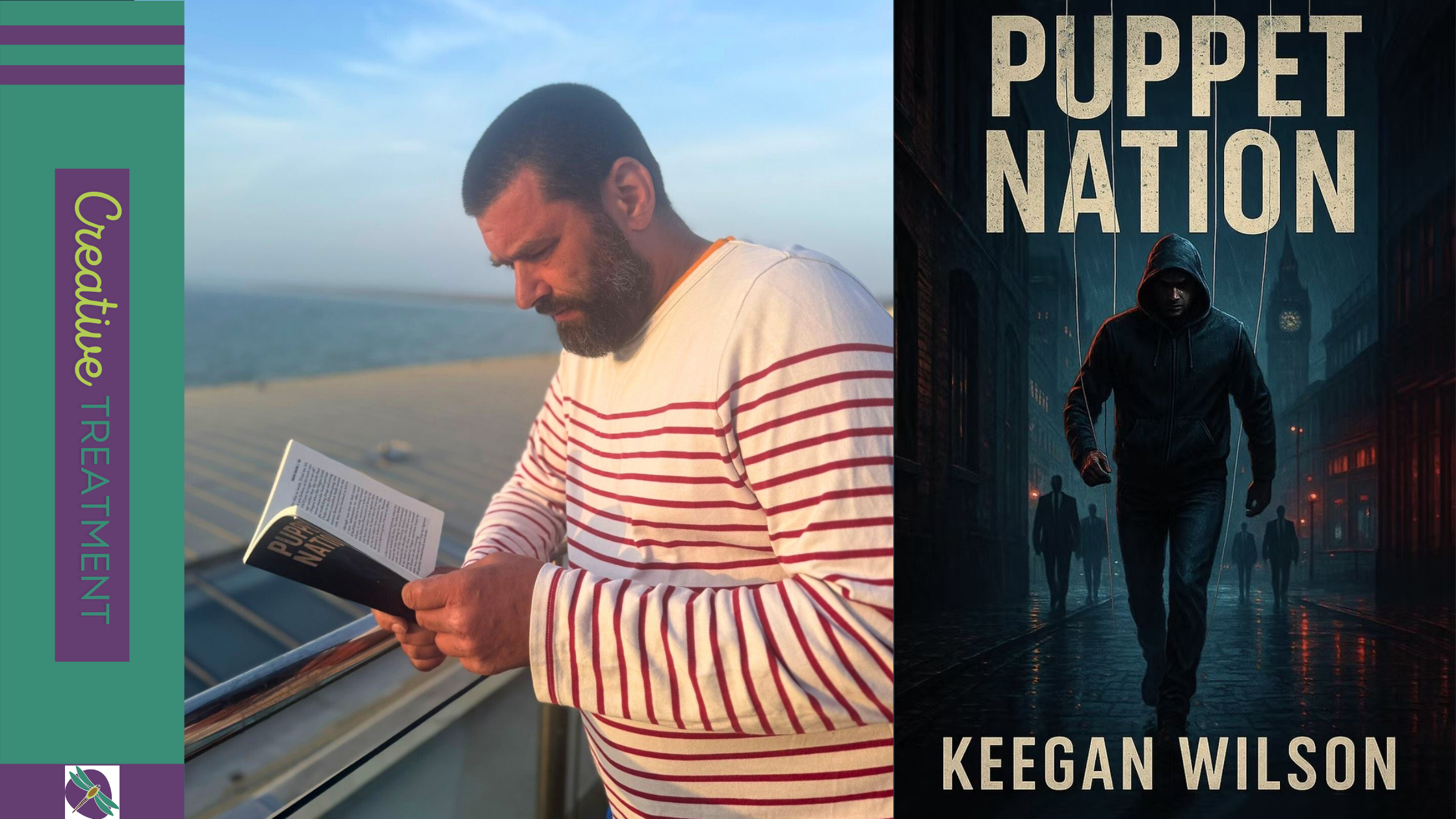
In the inaugural Creative Treatment interview, Chichester Copywriter’s Katy Lassetter talks to author and musician Keegan Wilson about how creative writing has helped him through chronic pain.
Keegan Wilson’s first book, Puppet Nation, will be published on 25 August. Writing and publishing a book is an uphill struggle for most. But Keegan’s achieved this while coping with chronic pain and struggling with his mental health.
He believes there’s a connection between our subconscious and creativity – if a dream is a creation of our subconscious, our creativity and imaginings are an extension of that. With beautiful words and insight like that, why wouldn’t you read on to find out what makes Keegan’s creative heart beat?
What are your creative outlets?
I enjoy creative writing. It satisfies something inside me I can’t quite explain or properly understand. I just do it. It’s a compulsion. I write stories and my debut novel, Puppet Nation, has just been published. I’m also a prolific songwriter and create music that’s a little out there.
Tell us about your latest creative writing project?
I’m writing the sequel to Puppet Nation. I’m about two-thirds of the way in and, so far, it’s going well.
Due to numerous back surgeries, I’m in constant pain in the lower half of my body, and I’ve developed a neurological issue. These present a challenge when writing. I can’t sit or stand at a desk for long periods because it’s far too uncomfortable. So, I work in short spurts.
To ensure I maximise my creative writing time, I write the book in my head. I’ll walk the dog and arrive home with everything worked out. When I do sit or stand at a desk for half an hour or so, I make the most of that time.
I’m also working on a new collection of songs that are a huge shift from what I’ve done previously. I’ve ditched the acoustic guitar and psychfolk for something I’d describe as Beck meets Air meets Nine Inch Nails. And I’ve released a new album, Songs for Jayne, which features some of the best songs I’ve written to date.
How does creative writing help you?
I’ve always been creative and lived in my imagination. It comes naturally to me and, I suppose, if it helps me do anything, it helps me be myself. It is who I am.
I also believe there’s a connection between our subconscious and creativity. If a dream is a creation of our subconscious, then our creativity and imaginings are an extension of that. It’s only months later that I sometimes realise something I’ve created was my way of expressing a feeling or something that had been on my mind.
For example, in Puppet Nation, the central character shows many similarities to what I experienced after the last back surgery and descent into illness. I didn’t realise it at the time of writing. It wasn’t deliberate, but I can now see how my experiences are represented in him.
Why did you choose creative writing as your outlet?
It chose me. As a kid, I told stories, made jokes, wrote poems and so on. It seemed natural. I carried this into my adult life. My motivation is to satisfy the compulsion, the urge, the need to keep creating. I genuinely think if I didn’t, I’d go a bit crazy.
How does your creative outlet help others?
While I’m an analytical thinker, I don’t analyse what I do or its impact.
In the early 2000s, I started a magazine called Pop Cult, Essential Reading Material for the Bathroom. It featured short stories from known and unknown writers, and each story was illustrated. For a while, it achieved a bit of success/interest, and it provided a platform for new writers and illustrators to showcase their work.
Did you have any support or advice from a charity or medical professional?
Not in terms of creativity, no. But the Solent pain team gave me great advice on living and coping with chronic pain, and Steps2Wellbeing helped me out of a very dark place. I didn’t realise at the time how mentally sick I was, as well as being physically unwell. But looking back, I can now see it.
I’m glad I shared with professionals the darkness going on inside my head, and I’d tell anyone going through problems to reach out to professionals who can help them. Don’t be an island. Don’t go through it alone. A problem shared and all that.
Who are your creative heroes and why?
Where to begin. I have so many. The broad truth is, I admire and respect anyone who expresses themself by being creative. They’re all heroes to me, in a way. For me, art and creativity are the purest and most joyous human activities.
I have my favourites, of course, in music and writing. People whose work I turn to time and time again, and those who make me excited when I hear they’re about to publish a book or release an album. I’m reluctant to name names, because I will later kick myself for not mentioning this person or that.
I can tell you that the authors who helped inspire my thinking and creative process for Puppet Nation are Lee Child and his Jack Reacher series. I’d not read any of the Reacher novels, but I was aware of them, and I was thinking it would be fun to create an English version of what I imagined Reacher might be.
Ernest Hemingway for the brevity of his sentences. To keep the pace and suspense throughout, I deliberately tried to keep the sentences short for maximum impact.
James Ellroy and his Underworld US trilogy of books: American Tabloid, The Cold Six Thousand and Blood’s A Rover. I’m fascinated by America in the 1960s and 70s. These books manage to entertain while presenting a very compelling story of nationwide conspiracies involving the politics of the time, the CIA and the mafia. I can’t praise these enough.
Geoffrey Household, whose classic book Rogue Male was lent to me by a friend after my last back surgery. The book made me wonder if someone today who was highly trained could stay out of reach of the UK authorities and their surveillance technology. This was the initial premise for Puppet Nation.
What would you recommend to others suffering from chronic pain and or mental health conditions?
Seek help and don’t be afraid of being honest with yourself and those who can help you — be that medical professionals, friends or family. There’s no shame in how you’re feeling. All of this, everything that everyone is experiencing, is temporary. Nothing’s permanent. Things change.
On a personal level, I told my doctors I didn’t want to use opioids to control and manage my pain. My every waking thought was dominated by pain and how much it hurt. It was so bad I couldn’t even read. I’d get halfway through a sentence and my body would be screaming and my mind would be going, “Oh my ******* Christ, my god this ******* hurts.”
I needed to find another way to make it back to myself. So, I began meditating and doing breathing exercises. I’d do these three or four times a day and at night. Anything to calm my body and mind down. I discovered an Australian called Jason Stephenson who has lots of guided meditation videos on YouTube. One day, I hope to meet him and shake his hand to thank him for what he’s done and what it’s meant to me.
Another important thing is to be kind to yourself. I struggle with this. There’s so much that needs doing around my house and in the garden, but my condition prevents me from doing too much. This is an enormous source of frustration to me, because I enjoy those activities and know I was once capable. So, I keep having to be kind to myself and not beat myself up about it.
What’s your favourite exercise to help sustain your creativity and health?
Walking. I once heard we have our best and most creative thoughts just before sleep and when walking. After becoming ill, I got myself a dog to force myself to move and walk. The dog has given me a responsibility, and when it’s just us walking through nature, I can lose myself in thoughts. I arrive home with fully formed chapters or songs.
What supportive words would you offer to others about using creativity to help them through?
Don’t worry about creating for other people, an audience, do it for yourself, because you’re creating to temporarily distract and divert your mind and senses away from whatever negative experience you’re going through. If other people like what you’re doing, it’s a bonus, but it shouldn’t be the objective.
Do you have any plans for future creative projects?
Always…
I couldn’t have asked for a better and brighter introduction to Creative Treatment! Thanks so much, Keegan, for your wonderful words and thoughtful advice. Well done again for this awe-inspiring achievement of creativity through adversity. I look forward to listening to your tunes, and here’s to book two!
What’s Creative Treatment?
What inspired me to start this new interview series? It’s pretty hard to follow Keegan and his creative writing achievements, but I’ll give it a good go…
Well, I already interview self-publishing authors to support them and provide insight for my self-publishing clients. But Keegan didn’t quite fit that bill, as he’s traditionally published (no shade, just not my area).
After connecting with him on LinkedIn, I was so inspired by his creative writing and publishing story that I had to know more. That same week, I met an arts psychotherapist (look out for interview two) and was further stirred by how she helps to bolster wellbeing with creativity.
I realised three things I wanted:
- To meet more fabulous people who support the creative arts and/or the wellbeing industry, who may also use creativity to help themselves through adversity.
- To tell their wonderful stories to further support those industries, which mean a lot to me.
- To help spread the word about and increase understanding of invisible, unknown and misunderstood conditions – like chronic fatigue, chronic pain, mental health conditions and neurodiversity.
Next, I needed a name. LinkedIn was the logical place to get input from lovely, creative and wellbeing experts in a poll. The winning name was Creative Cure, but it wasn’t right. I’m well aware that many chronic and mental health conditions have no cure, and I didn’t want to perpetuate the myths I’m trying to eradicate. So, Creative Treatment was born, and here we are!
Empathic creative writing that resonates
I have experience of living with chronic pain as well as chronic fatigue. Like Keegan, creative writing is one of my favourite outlets. At the weekends, I wander gently through woodlands and waterways, kicking back with kingfishers and dragonflies. Instagram’s my place to share nature writing and wildlife photography.
During the week, I’m a copywriter, editor and proofreader. I create empathetic content for the likes of arts education charities and wellbeing organisations, such as the Federation of Holistic Health (FHT).
Would you like words that attract your ideal health and wellbeing customers/clients or make your creative arts community/subscribers feel seen? I can understand your clients or community, what their problems are and how you can solve them. I’ve been there and identify with their issues.
Get in touch with a considerate and creative writer. Email Katy@ChichesterCopywriter.co.uk or call 07986 802194, Tuesday-Friday (10.00-18.00).